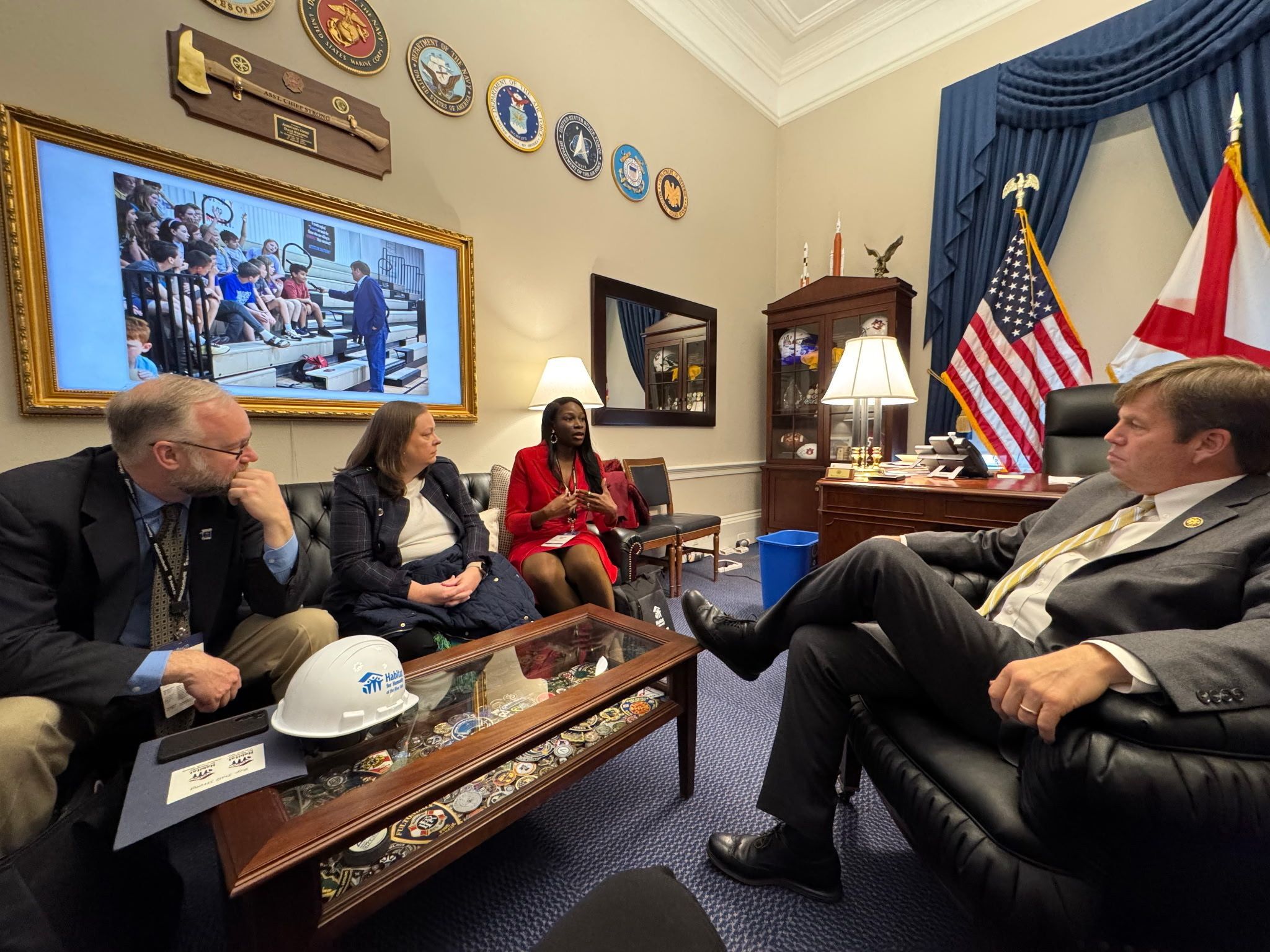
During Habitat on the Hill, a three-day, D.C. based event, Alabama Habitat for Humanity members joined advocates from 47 other states, Washington D.C. and Puerto Rico to meet with Congressional leaders. Direct meetings were held with Representatives Aderholt, Strong, and Figures – also meeting with legislative staff from Representatives Sewell, Rogers, Moore as well as Senators Tuberville and Britt.
Affordability remains a top issue facing Alabamians, as rural, urban, and suburban communities nationwide are experiencing this historic loss of affordable homeownership opportunities, which is driving the overall crisis. The shortage of starter homes impedes workers’ access to job markets with economic opportunities, holds back local economies, exacerbates the wealth gap, and keeps millions of would-be homebuyers in the rental market.
“Homeownership represents the American Dream,” said Dr. Sasha Irby, a Habitat homeowner present at the event from the Habitat for Humanity of the River Valley program.
For the first time in recent decades, there is growing momentum in Congress to tackle the issue.
Both the House and Senate have taken important steps in advancing bipartisan housing legislation – the Senate through the ROAD to Housing Act (S. 2651) and the House recently passing the Housing for the 21st Century Act (H.R. 6644) on Monday, February 9, by an overwhelming bipartisan vote, 309-9. All of Alabama’s House delegation voted in favor of this legislation, which aims to ease the affordability crisis and increase homeownership.
“We know that solving the housing crisis requires meaningfully increasing the supply of affordable starter homes,” said Shae Hines, Executive Director, Escambia County Habitat for Humanity. “We need bold policy action, and we’re committed to partnering with lawmakers who share our desire for every family to have access to a safe, decent and affordable place to call home.”
In addition to the legislative priorities above, Alabama Habitat advocates urged representatives to:
- Fund the Self-Help Homeownership Opportunity Program (SHOP) at no less than $20 million in the Transportation-HUD appropriations bill.
- Fund the Home Investment Partnerships Program (HOME) at no less than $1.5 billion in the Transportation-HUD appropriations bill.
- Fund the USDA Section 502 Direct Loan Program at no less than $1.25 billion in the Agriculture, Rural Development, Food and Drug Administration appropriations bill.
This year advocates also called on elected officials to act and champion Habitat’s legislative priority, the Homeownership Supply Accelerator, a plan designed to rapidly increase construction of affordable homes in the United States.
The Homeownership Supply Accelerator aims to create a source of flexible financial assistance that supports property acquisition, new home construction and rehabilitation, and other financial barriers faced by for-profit and non-profit developers serving modest-income homebuyers
“As the Habitat network raises its collective voice to call for national action, we know that change can start right here at home,” Hines continued. “The first and best place to start in Alabama is funding the Alabama Housing Trust Fund; established in 2012 but with no funding or dedicated revenue stream. It's meant to provide flexible funds for construction, rehabs, and assistance for low-income households, veterans, and people with disabilities, addressing Alabama's significant housing shortage.”
This milestone year marks the 20th Habitat on the Hill coinciding with Habitat for Humanity’s 50th anniversary. Over the last five decades, Habitat has helped more than 65 million people build or improve the place they call home.